


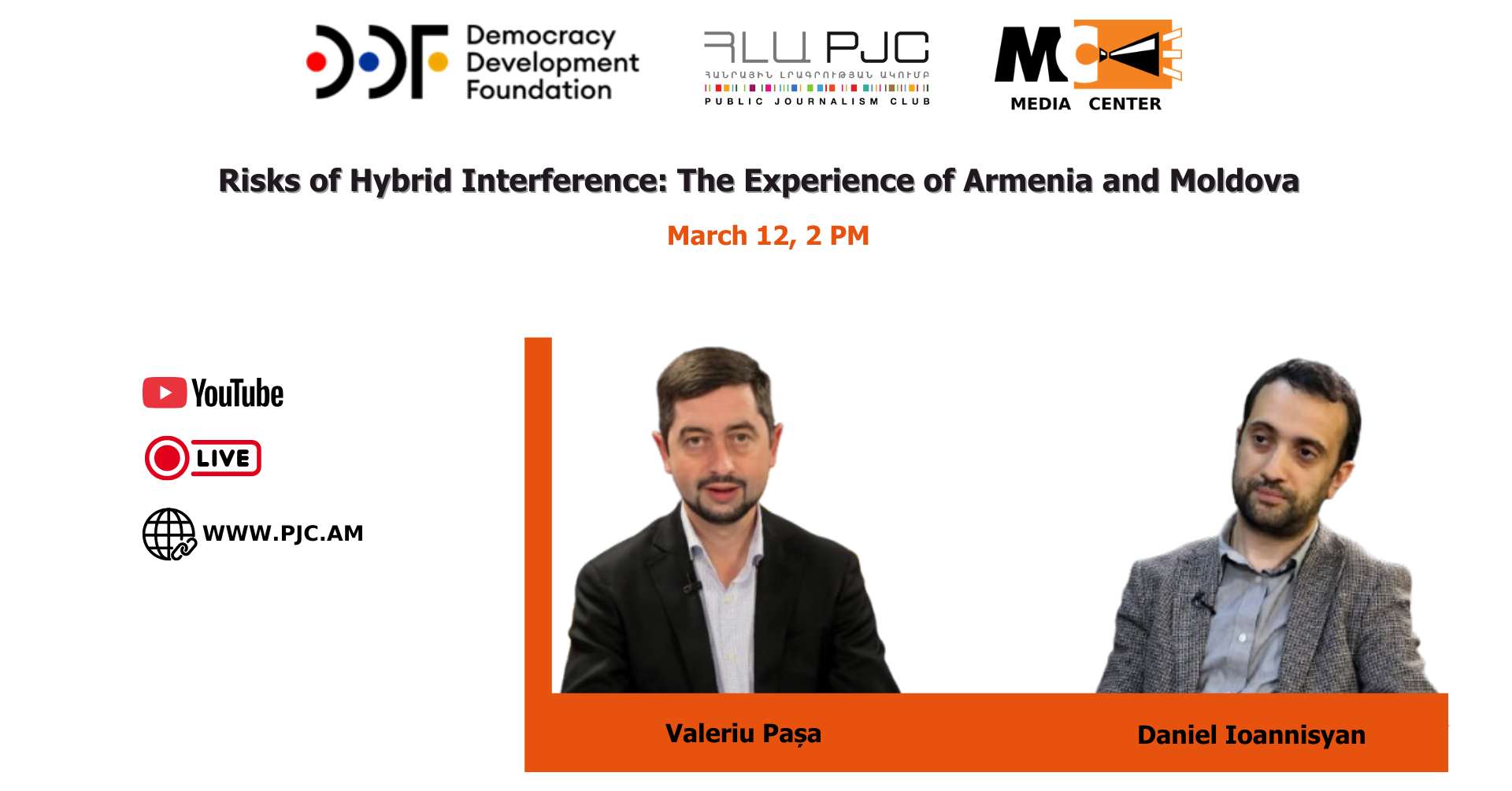
On March 12, the Media Center hosted a discussion titled “Risks of Hybrid Interference: The Experience of Armenia and Moldova.”
The speakers were political analyst and head of the WatchDog.md community, Valeriu Pașa from Moldova and Daniel Ioannisyan, head of the “Union of Informed Citizens” NGO․
It is worth recalling that Moldova’s 2024 electoral processes took place amid active Russian interference, accompanied by propaganda and other hybrid challenges. Nevertheless, the parliamentary elections held on September 28, 2025 resulted in victory for the ruling party supporting Moldova’s European integration.
“According to our calculations, Russia spent about 150 million euros in 2024 alone to interfere in elections and referendums. For Vladimir Putin, this is not a large amount, but it is a substantial resource for influencing another country’s electoral process,” Pașa said.
According to Pașa, countering disinformation and external interference in elections requires joint efforts by the state, civil society, independent media, and active citizens. In his assessment, Moldova’s state institutions carried out extensive work to combat illegal financing from the Russian Federation, which was used to support political parties, bribe voters, and spread disinformation. Law enforcement agencies conducted investigations and seized significant amounts of cash. The authorities also improved transparency and communication with the public.
During the discussion, participants also addressed the recent statement by Armenia’s Foreign Intelligence Service, the mechanisms of external pressure and possible hybrid influence, as well as their potential impact on Armenia’s pre-election processes.
Ioannisyan confirmed that there is credible information suggesting that attempts are being made to pressure Armenian business owners and their employees in order to influence voting in favor of certain candidates through monetary bribes or threats. According to Ioannisyan, there have also been indications of possible preparations to involve foreign nationals in the elections. Based on statistics from previous years, from late May to early June around 15,000 people enter Armenia daily—about 10,000 foreigners and 5,000 Armenian citizens. According to him, organizing voting by such individuals is often planned several weeks before election day.
He also emphasized that Armenia provides for strict criminal liability for both giving and receiving electoral bribes. Giving a bribe can result in up to eight years’ imprisonment, while receiving one can lead to up to seven years. At the same time, individuals who voluntarily report receiving a bribe to law enforcement authorities may be exempt from criminal liability.
Speaking about sociological surveys and their manipulative role, Valeriu Pașa noted that certain regulations had been introduced in Moldova to address this problem. These required organizations to obtain accreditation and disclose their funding sources. However, this mechanism did not produce the desired results: organizations often claimed that surveys were financed through their own resources or those of media outlets that lacked sufficient means to conduct such research.
He also highlighted the particular influence of TikTok, noting that its algorithms can quickly shape users’ behavior and political preferences. Unlike Facebook and YouTube, TikTok can rapidly increase public support for a particular party or candidate and directly influence voter behavior.
According to Daniel Ioannisyan, combating armies of fake accounts and manufactured waves of support is extremely difficult. He referred to the “rational choice theory,” according to which people tend to support political forces they believe already enjoy broad public backing.
From this perspective, these phenomena can be divided into three problems: the imitation of support on social networks through fake comments and likes, the imitation of public support through fake sociological surveys, and the imitation of support through rallies and gatherings. Ioannisyan noted that the purpose of countering these three phenomena is to prevent the formation of a manipulative public perception about the real level of support for political forces. Today, he added, these practices are particularly widespread on social networks.
The discussion concluded with the observation that external interference and manipulation can affect both voters’ perceptions and the post-election situation. According to the experts, the most effective response remains the active participation and balanced engagement of state institutions, civil society, independent media, and the public.
The discussion was held within the framework of the program “Media Center: Civil Society Rapid Response for Fair Elections”. The program is implemented with the support of the Democracy Development Foundation as part of the “Partnership for Democracy” initiative.
The Public Journalism Club bears responsibility for the content, which does not necessarily reflect the views of the Democracy Development Foundation.