
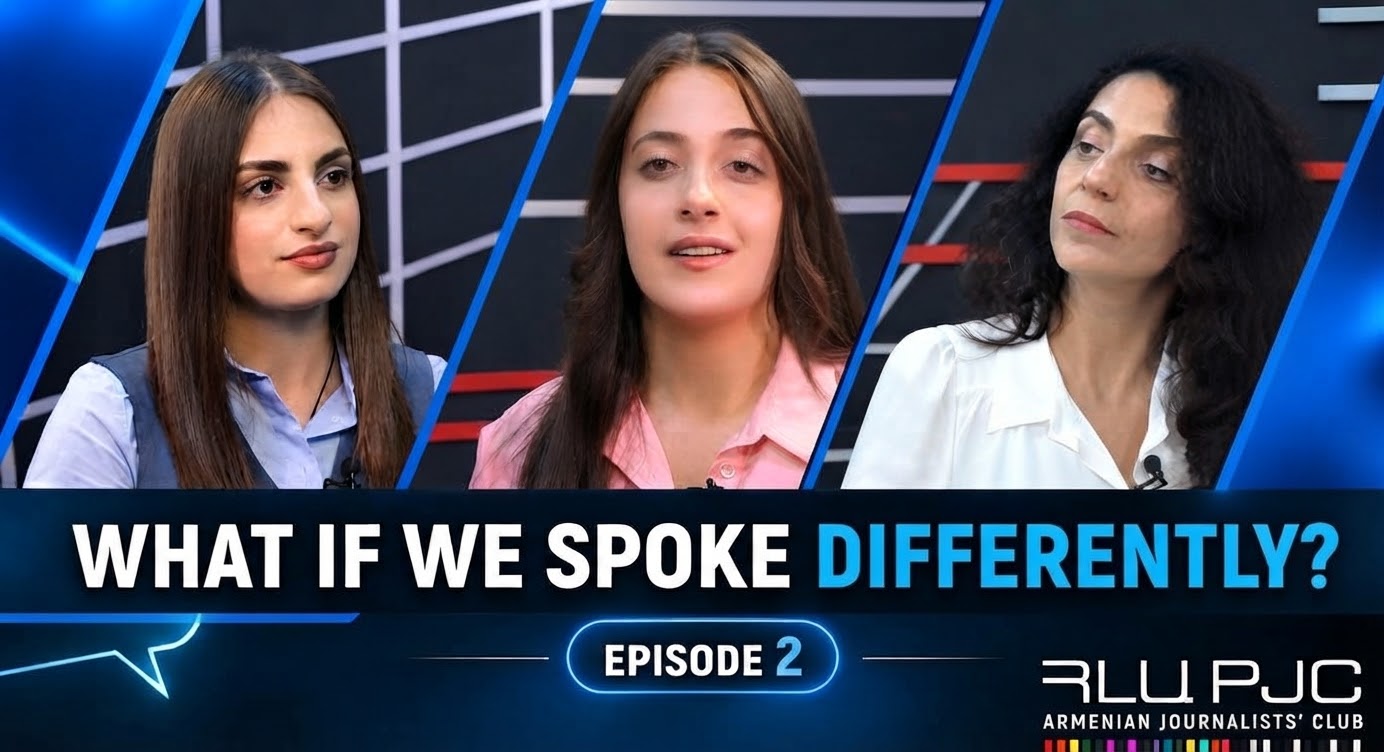
s it possible to truly listen to someone when what they are saying causes us pain? If we try to understand their experience, does that mean we agree with them? And can we acknowledge another person’s pain without diminishing our own experience or position? These are the questions explored in the second episode of the podcast “What If We Spoke Differently?” Hosted by Sofi Mkrtchyan, the episode features nonviolent communication specialists Gohar Grigoryan and Margarita Khudaverdyan.
We Often Listen in Order to Respond
Listening during conflict is difficult. Especially when a topic is sensitive to us, we often do not try to understand what the other person is saying. Instead, we wait for our turn—to respond, clarify, challenge, or defend our position.
At that point, a conversation can turn into two parallel monologues. Each person speaks about their own truth, but neither is truly listening to the other. Nonviolent Communication (NVC) encourages us to distinguish between listening and agreeing. We can understand that a person is afraid without agreeing with their conclusions.
We can acknowledge that their experience has been painful without giving up our own experience. We can try to understand what the other person needs without justifying all of their actions or words. This distinction matters not only in personal relationships, but also in social and peacebuilding processes.
Empathy Is Not About Giving Advice
When someone tells us about their pain or a difficult situation, we often immediately want to help.
- We give advice.
- We try to explain things.
- We say, “Don’t think about it,” or “If I were you…”
But sometimes what a person needs is not a solution, but the experience of being heard. In NVC, empathetic listening means trying to understand what a person is feeling and what matters to them. At that moment, the question is not whether their version of the story fully matches our own understanding, but whether we can stay with their experience for a moment without immediately judging or correcting it.
Understanding Is Not Justification
This distinction is especially important in polarized societies and in contexts of conflict. Listening to another person’s pain does not erase our own pain. Understanding their needs does not mean abandoning our own needs. Empathy does not require us to give up questions of responsibility, justice, or our own boundaries. It simply allows us to see the person behind positions and narratives. This is where NVC can become a valuable tool for peacebuilding. In conflicts, parties often listen to one another only from the perspective of proving or disproving their own narratives. But when it is possible to create a space where people can listen to each other’s experiences without requiring agreement, a different possibility can emerge in the relationship.
Shared Needs Behind Different Positions
People can hold completely opposing positions and still have very similar needs: safety, respect, recognition, justice, dignity, and belonging. This does not automatically create agreement. But when a conversation is not solely a struggle between positions, it can sometimes become possible to see what people have in common.
NVC encourages us to explore precisely this layer:
- What is actually important to me?
- What is important to the other person?
- And can we continue the conversation even when our answers are different?
Listening Without Losing Ourselves
Listening with empathy does not mean remaining silent. Healthy communication is two-way. We can listen to the other person and then speak just as clearly about our own feelings, needs, and boundaries. The goal of peacebuilding is not necessarily to eliminate all differences. A more realistic question is this: Can we live, communicate, and cooperate on certain issues even when deep disagreements remain between us?
That culture begins with the ability to listen.
- Not to agree.
- But to understand․
In the second episode of the podcast, Sofi Mkrtchyan, Gohar Grigoryan, and Margarita Khudaverdyan discuss what it means to listen, where the boundaries of empathy lie, and why this skill matters not only in our everyday relationships but also in peacebuilding.
Listening does not mean agreeing. But without listening, it is difficult even to understand what we actually disagree about.
The podcast was produced by the Public Journalism Club within the framework of the “Bridge – Relationship Building and Inclusive Dialogue Based on Genuine Compassion” program