
How can external influence be countered when it is spread not only through political statements, but also through social media, anonymous websites, Telegram channels, fake opinion polls, and content generated by artificial intelligence?
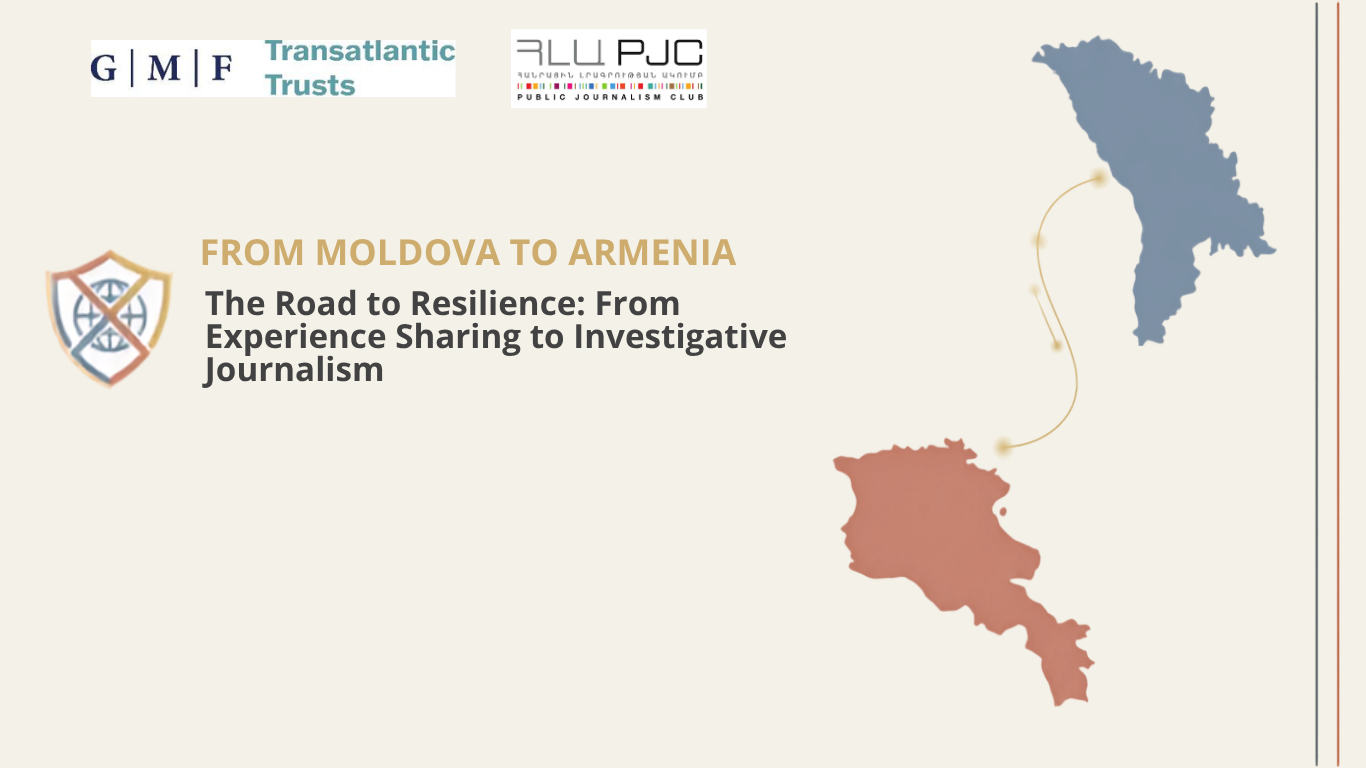
This question was at the heart of the Public Journalism Club’s project, “Learning from Moldova: Building Armenia’s Democratic Resilience” The initiative aimed not merely to present Moldova’s experience in Armenia, but to translate it into journalistic practice, professional collaboration, and a post-election resilience agenda.
The project was implemented by the Public Journalism Club from December 1, 2025, to June 30, 2026, with financial support from the Black Sea Trust for Regional Cooperation – a project of the German Marshall Fund of the United States.
Studying How Influence Networks Operate
During the first phase of the project, from March 23 to 25, investigative and fact-checking journalists, along with representatives of media organizations from Armenia, visited Moldova.
The Armenian delegation met with representatives of TV Nord, 24 Martie, ADEPT, Ziarul de Gardă, API, RISE Moldova, Cu Sens, and NordNews. Discussions focused on external interference in electoral processes, networks of political and financial influence, disinformation campaigns, and the tools used to uncover and investigate them.
One of the key features of Moldova’s experience was the systematic cooperation between the media and civil society. Independent media outlets not only responded to false information after it had been disseminated, but also investigated financial flows and the links between political actors, intermediary organizations, and information networks.
“The need to counter disinformation and external influence exists in our country as well,” said Lusine Hakobyan, a journalist at Hetq, after the visit to Moldova, emphasizing that the risks of information manipulation increase significantly during election periods.
Turning Experience into Journalistic Work
The study visit to Moldova was followed by the practical phase of the project. Participating journalists examined the mechanisms of influence operating within Armenia’s information environment to determine who is attempting to shape public opinion and voter behavior, through which platforms, and by what means.
As part of the project, four investigative and analytical reports were produced.
☑️ “Artificial Reality: The New Digital Propagandists” analyzes 229 AI-generated videos published across 52 TikTok and Facebook pages. The study demonstrates how AI-generated content has been used for political manipulation and to disseminate specific narratives.
☑️ “The hidden players in Armenia’s election polling market” examines sociological polling organizations of questionable origin that became increasingly active ahead of the elections, their possible links to Russia, and the risks of influencing public opinion through unreliable polling data.
☑️ In the investigation “How Do Telegram Channels Interact During the Election Period? A Look at Direct Links and Reposts” Hetq analyzed publications from two Telegram channels to identify similarities in their content, direct references, cross-posting practices, and possible coordinated activity.
☑️ “Digital Manipulation and Invisible Influence in Armenia’s Elections” maps the mechanisms of influence ranging from fake websites and bot activity to the coordinated dissemination of narratives and attempts to manipulate search engines and AI tools.
These publications are among the project’s most tangible outcomes. The study of international experience was transformed into evidence-based journalistic work focused on Armenia’s information environment.
From Individual Investigations to a Coordinated Response
The Armenia-Moldova Workshop, held in Yerevan on May 23, brought together journalists, media professionals, and representatives of civil society and the communications sector from both countries on a single platform.
Vladimir Thorik, Editor at RISE Moldova, and Yuliana Volkova, Editor-in-Chief of NordNews, presented how their newsrooms investigated the connections between political actors, influence brokers, and proxy structures.
“Complex data must be transformed into evidence-based public investigations,” Vladimir Thorik emphasized, summarizing one of the key principles drawn from Moldova’s experience.
The workshop addressed the early detection of manipulative narratives, the tracing of shadow financing, the protection of state institutions, cooperation among media organizations, and the preservation of public trust in the post-election period. The outcomes of the group discussions were consolidated into a “Resilience Roadmap,” offering recommendations for the future work of media organizations and civil society.
Elections End, Information Pressure Does Not
The questions and recommendations developed throughout the project were further advanced on July 10 during the discussion “Post-Elections: The Resilience Agenda for Media and Civil Society.”
“Information attacks do not end once the election results are finalized,” said Seda Muradyan, President of the Public Journalism Club, emphasizing that cooperation between the media and civil society must continue beyond the electoral period.
Irina Neagu, Black Sea Regional Programs Director at the German Marshall Fund of the United States (GMF), who joined the event online, also drew attention to the post-election period:
“It is precisely during this period that we must intensify our efforts to build resilience.”
The discussion also benefited from the contributions of Lilia Zaharia, Executive Director of Transparency International–Moldova; David Amiryan, Chair of the Board of the Armenian Scientific Association of Psychologists NGO; human rights defender Zaruhi Hovhannisyan; Sona Ayvazyan, Executive Director of Transparency International Anti-Corruption Center NGO; David Petrosyan, Co-founder of the Yerevan Center of Foreign & Security, Ashot Melikyan, Chairman of the Committee to Protect Freedom of Expression; Ani Grigoryan, journalist at CivilNet; Kristina Barseghyan, Executive Director of Hetq; and Corina Cepoi, Head of the Independent Media Support Program in Moldova.
The panel discussions were moderated by journalist Lilit Avagyan, Coordinator of the PJC Media Center.
The discussions resulted in several key priorities: restoring the proactive role of civil society, strengthening engagement with citizens, protecting independent media, fostering professional solidarity among media organizations, and responding to hybrid threats through coordinated action rather than isolated initiatives.
“If society does not have a voice through the media, the consolidation of democracy will be seriously jeopardized,” said Kristina Barseghyan, Executive Director of Hetq.
Moldova’s experience demonstrated that democratic resilience is not the product of a single institution or a single project. It is built when independent journalists are able to uncover influence schemes, civil society can safeguard the public interest, and different stakeholders can rapidly exchange information and respond to threats collectively.
Armenia’s experience, in turn, confirmed that international knowledge acquires real value when it is adapted to the local context and translated into concrete action—through investigations, cooperation, and the shaping of the public agenda.
More detailed information about the project is available on the Public Journalism Club (PJC) website.