
What happens when we begin to perceive disagreement not as a difference of opinion, but as a personal attack? “If you disagree with me, then you are against me”—does this way of thinking sound familiar? What accusation lies behind the statement, “If you respected me, you wouldn’t act this way”? And how can we express anger without offending another person’s dignity? These are the questions explored in the third episode of the “What If We Spoke Differently?” podcast.
Host Sofi Mkrtchyan discusses these issues with nonviolent communication specialists Gohar Grigoryan and Margarita Khudaverdyan.
Disagreeing with an idea does not mean rejecting a person
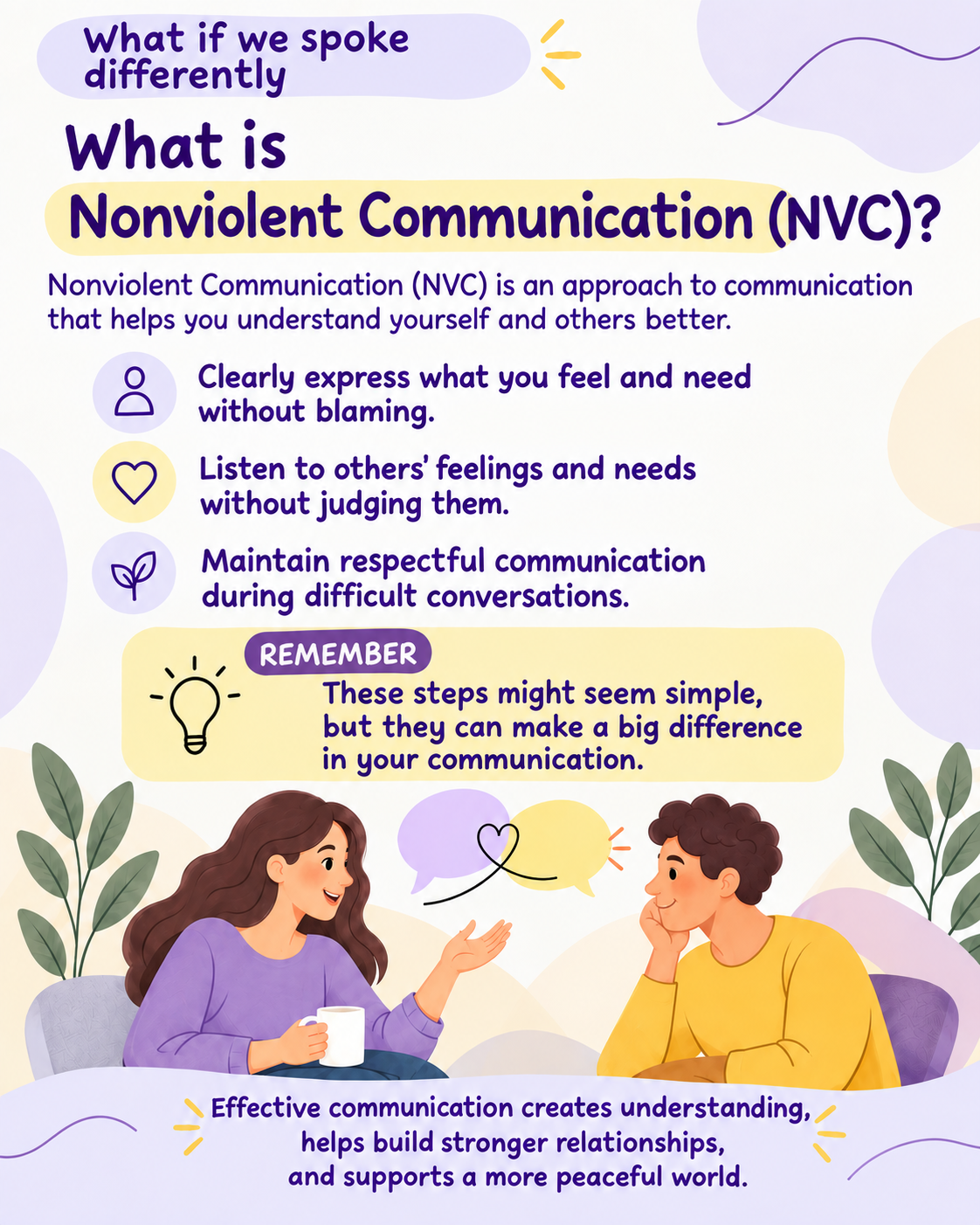
People often identify so strongly with their opinions that they perceive criticism of an idea as criticism of themselves. This gives rise to the belief that disagreement is equivalent to disrespect or a lack of affection. NVC encourages us to make a distinction: the “you are wrong, I am right” approach labels a person, whereas identifying a specific action—by exploring which of our needs were unmet as a result and how we felt—creates an opportunity for peaceful dialogue.
Anger is not a bad act, but a signal
In Nonviolent Communication, there are no good or bad feelings. Anger signals that a boundary or an important need may have been violated. Instead of telling ourselves that “anger is shameful,” we can ask: What was violated, and how can we address it?
The accusation “You made me angry” does not hold up under closer examination, because our feelings arise within us and are connected to our unmet needs. The same delay may irritate one person and please another, depending on their needs at that particular moment.
Saying “NO” does not mean destroying a relationship
NVC encourages us to say “NO” by rejecting not the person, but the strategy or proposal being offered at that particular moment. We must also learn to hear other people’s “NO” without interpreting it as a rejection of us.
When safety and peace are at risk, we are free to take a break and discontinue communication. Using protective force is not necessarily violence; the distinction lies in the intention: is the aim to stop a blow, or to inflict pain and humiliation in return?
Is empathy a betrayal?
During conflicts, empathy is often mistaken for betrayal. However, empathy does not mean feeling the same pain or sharing another person’s conclusions. It means understanding what a person is feeling and what they need.
Listening to another person’s pain does not erase our own. Understanding their needs does not mean abandoning our own experiences, boundaries, or questions of justice.
Language as a tool for peace or division
Journalists and those who shape public discourse are responsible not only for the information they communicate, but also for the language they use when discussing conflicts.
Dehumanizing language strips people of their human qualities. When the media reproduces such language, it can appear to give public permission to use the same vocabulary. There is a difference between the terms “enemy” and “party to a conflict”: the former carries political and psychological connotations, while the latter is a factual description.
In the third episode, Sofi Mkrtchyan, Gohar Grigoryan, and Margarita Khudaverdyan discuss how to express disagreement and anger without undermining another person’s dignity; how to distinguish criticism of an action from labeling a person; what it means to say “NO” without losing a relationship; and why the use of protective force may sometimes be justified.
Disagreement does not mean becoming enemies. Recognizing this distinction, while learning to listen to one another, can be a valuable tool for peacebuilding.
The podcast was produced by the Public Journalism Club within the framework of the “Bridge – Relationship Building and Inclusive Dialogue Based on Genuine Compassion” program in partnership with International Alert and LIVKOM. The program is funded by the New Democracy Fund.